


Painting
God of Mountain “Shichimen Tennyo (The Celestial Nymph of Mount Shichimen)”


Story
In Hayakawa, Yamanashi Prefecture, where I live, there is a sacred mountain called Mount Shichimen.
For centuries, Mount Shichimen has been revered as a sacred site dedicated to Shichimen Daimyōjin, a dragon deity regarded as a protector of the Lotus Sutra. Shichimen Daimyōjin is said to appear in human form as a beautiful woman.
Mount Shichimen has also long been a place of spiritual training for *yamabushi*, mountain ascetics. Its trails are steep and demanding, and natural disasters can dramatically alter the landscape. The mountain villages at its foot have repeatedly been affected by such disasters, and generations of people have lived alongside the immense forces of nature.
My own studio stands at the foot of Mount Shichimen, and I live each day with the presence of this mountain close at hand.
When I imagine Shichimen Tennyo from this place, I do not see a gentle, serene goddess. Instead, I envision a woman with a powerful gaze, moving freely across this rugged mountain.
In this work, I painted my own vision of Shichimen Tennyo.
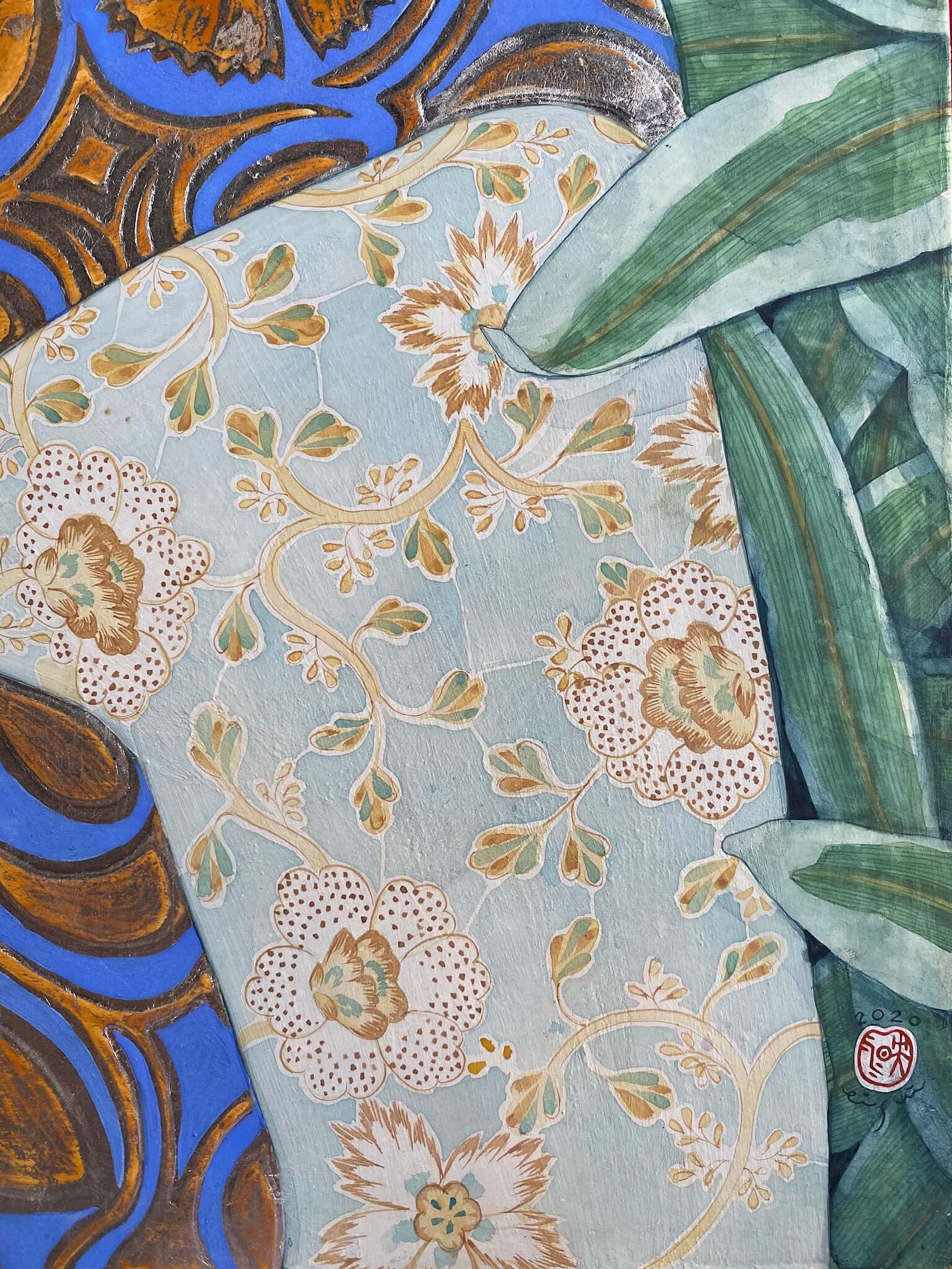
For her clothing, I drew inspiration from the traditional dress of peoples who live close to the land, incorporating patterns from *Edo Sarasa* and *Sakai Sarasa*. Above her head, I painted a dragon as an expression of her identity as a dragon deity.
The dense *Ōkumazasa* bamboo grass that fills the background was painted from my memory of walking Mount Shichimen, when it grew thickly along both sides of the mountain path.
Several years ago, the bamboo grass flowered all at once. It has since withered away, and the landscape I remember can no longer be seen.
**A landscape of Mount Shichimen that has now disappeared remains within this painting.**
For the blue fabric draped from her shoulder, I also used lapis lazuli, a stone traditionally associated with protection from evil.
Summary
God of Mountain “Shichimen Tennyo (The Celestial Nymph of Mount Shichimen)”
Media: Wood panel, soil, Kōsai (Japanese tube paint), mineral pigments, Gofun (powdered chalk made of shells), acrylic emulsion, and gold leaf,silver leaf,tamamushi leaf
Size: About F25
Year: 2020
Collection: Takeibō, Minobusan Shukuin, Nichiren Buddhist Temple
It is also being sent out here. Please take a look.


Please contact us by Email.
Please feel free to contact us for more information about our activities and works.